
The most effective lice treatment is a head lice medicine, chosen with your child’s doctor and used exactly as its label directs. The American Academy of Pediatrics puts it plainly: head lice medicine is the most effective way to treat head lice, and it is best to call your pediatrician before treatment. The products differ in the ages they are approved for and in whether they kill eggs, and that is where your real decision sits.
Before You Treat, Make Sure You Are Looking at Live Lice
Treat only when you have found live lice. The CDC says finding a live nymph or adult louse on the scalp or hair is the best way to diagnose an infestation, and the AAP says head lice medicine should be used only when it is certain that your child has living head lice. The CDC calls misdiagnosis common, and says nits get confused with dandruff, hair spray droplets and dirt particles. The AAP’s test: nits are firmly attached to the hair, and dandruff and dirt are not.
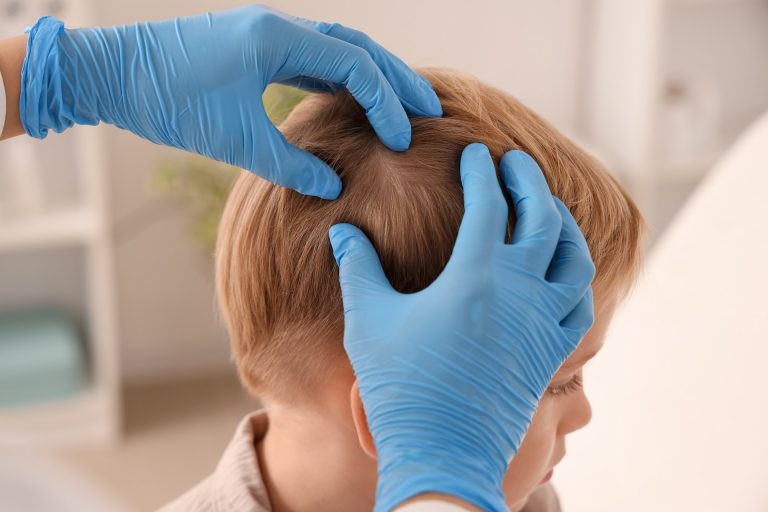
Live lice avoid light and move quickly, and an adult is roughly 2 to 3 mm long, about the size of a sesame seed, so use bright light, a magnifying lens and a fine-toothed comb. The AAP suggests seating your child in good light, parting the hair, combing small sections, and wiping the comb on a wet paper towel after each pass; start at the hairline at the back of the neck and behind the ears, which it calls the easiest place to find them.
Distance from the scalp matters. The CDC says nits attached more than 1/4 inch from the base of the hair shaft are almost always hatched or dead, and that when those are the only nits you find, the infestation is probably old and does not need treatment. If you are not sure, the CDC says to see your healthcare provider.
Lice Medicines Side by Side: Age, Eggs and the Second Treatment
The CDC says both over-the-counter and prescription medications are available to effectively treat head lice, so the comparison that matters is not shelf against pharmacy counter. It comes down to three questions: how young a child the label covers, whether the medicine kills eggs as well as lice, and what the CDC says about treating a second time. Here is how its clinical guidance on head lice describes each active ingredient.
| Active ingredient | Age on the label (CDC) | Kills eggs? | Second treatment |
|---|---|---|---|
| Permethrin lotion, 1% | Two months and older | Live lice, not unhatched eggs; can keep killing newly hatched lice for several days | May need a second treatment on day nine |
| Pyrethrins with piperonyl butoxide | Two years and older | Live lice only, not unhatched eggs | Second treatment 9 to 10 days after the first |
| Benzyl alcohol lotion, 5% | Six months and older | Lice but not eggs | Treat again after 7 days |
| Ivermectin lotion, 0.5% | Six months and older | Lice, not eggs, but appears to prevent newly hatched lice from surviving | Not for retreatment without talking to a provider |
| Malathion lotion, 0.5% | Six years and older | Live lice and some lice eggs | If live lice are still present 7 to 9 days later |
| Spinosad 0.9% topical suspension | Six months and older | Live lice and unhatched eggs | Retreatment usually not needed; no nit combing required |
The CDC adds two cautions the columns cannot hold. Lice have developed some resistance to 1% permethrin, and the efficacy of pyrethrins may be reduced by resistance, with the prevalence unknown in both cases. Malathion can irritate skin and is flammable.
The age column deserves a second look. The CDC says to consult your healthcare provider before treating young children, and our guide to lice treatment options for toddlers under 2 covers that conversation. Your pharmacist or your child’s doctor can tell you which of these needs a prescription. Whatever you choose, use the medicine as directed on the box or label, follow the package directions exactly as written, and have an adult apply it. The CDC warns that these drugs are insecticides that can be dangerous if misused or overused, and that two lice drugs should not be used at the same time unless a provider or pharmacist says so.
If the First Treatment Did Not Work, Check These Five Things
The CDC lists five reasons a head lice treatment fails:
- Misdiagnosis: there were no living lice to treat.
- Recent application of a combination shampoo and conditioner, or of conditioner, before the medicine; the CDC says not to use either beforehand.
- Not following the treatment instructions.
- Head lice resisting the medication.
- Reinfestation after successful treatment.
The CDC says it takes time to kill all the lice, and that a few lice still moving slowly 8 to 12 hours after treatment do not call for another application. Treat again only if live, crawling lice turn up several days later, and talk to your healthcare provider before re-treating. The CDC also says not to treat one person more than 2 to 3 times with the same medication when it is not working, and to consider a different medication if crawling lice survive a full course and a retreatment. The AAP says to check with your child’s doctor before starting a second or third medicine, which may be the same product again or a new one.
Resistance is real, and local. The AAP says head lice can be resistant to the active ingredients in over-the-counter treatments in some communities, that the likelihood of resistance varies across the country, and that parents sometimes treat their children up to 5 times before asking their pediatrician for help. Nits still stuck to the hair are not proof of failure: the CDC says nits may stay in hair after treatment, but successful treatment will kill crawling lice. Our notes on what dead lice look like after treatment and why you may still be finding nits go further.
What the Evidence Says About Natural Remedies and Kitchen Cures
There is no scientific evidence that suffocating head lice with mayonnaise, olive oil, margarine, butter or similar substances works, according to the CDC’s treatment guidance. The AAP says not to use home remedies such as petroleum jelly, mayonnaise, tub margarine, essential oils or olive oil, because no studies prove they work. Wanting a chemical-free option is reasonable; counting on a cupboard remedy to clear an infestation is the part that does not hold up. Our look at natural lice treatment takes the remedies one at a time.
Some home approaches are not merely ineffective. The AAP says never to use gasoline, kerosene or medicines made for use on animals, and warns that gasoline and kerosene are flammable and carry substantial risk. It also says it is dangerous to place anything made of plastic on a child’s head, so a plastic bag does not belong there. The CDC says fumigant sprays and fogs are not necessary to control head lice and can be toxic if inhaled or absorbed through the skin. Combing has a narrower role: the AAP says comb-out can help you check for nits and head lice, but adds that on its own it usually does not get rid of them.
What to Look For in a Lice Treatment Service
Judge a service by whether it checks everyone who could be carrying lice, confirms living lice before treating, and leaves you with a follow-up plan that matches what the CDC and AAP already advise. When you compare lice treatment services, ask specific questions:
- Do you check every household member and close contact? The CDC says to check all of them and to treat everyone infested, plus anyone they share a bed with, at the same time.
- What happens over the next three weeks? The CDC says to check the hair and remove nits and lice every 2 to 3 days for 2 to 3 weeks after each treatment.
- Will you send me back to my child’s doctor? The AAP says to ask your child’s doctor if you have questions or if the treatments you have tried have not gotten rid of lice.
Our breakdown of how long lice treatment takes sets expectations. The AAP says the lice cycle can repeat every 3 weeks when head lice are left untreated, and we check the whole family rather than one child.
Frequently Asked Questions
Is there one best lice medication?
No single product is best for every child. The CDC lists active ingredients that differ in the youngest age on the label and in whether they kill eggs, and says incorrect use or resistance can reduce effectiveness. The AAP says your pediatrician can help you choose an appropriate option.
How do permethrin and pyrethrins differ?
Mainly in the age on the label. The CDC says permethrin lotion, 1% is approved for children two months of age and older, while pyrethrins combined with piperonyl butoxide are approved from two years. Neither kills unhatched eggs, though the CDC says permethrin can kill newly hatched lice for several days after treatment.
Spinosad or ivermectin: what is the difference?
Eggs, and what happens next. The CDC says spinosad 0.9% topical suspension kills live lice and unhatched eggs, so retreatment is usually not needed and nit combing is not required. Ivermectin lotion, 0.5% kills lice but not eggs, appears to prevent newly hatched lice from surviving, and should not be used for retreatment without talking to a provider.
What if an over-the-counter treatment does not work?
Ask your health care provider for a prescription product, which is what MedlinePlus advises. The AAP says over-the-counter treatments are sometimes not the most effective and that lice can resist their active ingredients in some communities. The CDC says a provider may suggest a different medicine.
What is the most effective one-visit lice removal treatment?
That depends on the child, and a pediatrician should weigh in. The AAP says several prescription treatments suggest only one application, some have application times as short as 10 minutes followed by a simple rinse with water, and some do not call for nit combing. Our clinic’s non-toxic treatment is done in one visit.
How Lice Lifters of Ocean County Can Help
If you would rather not work through label ages and second-treatment schedules on your own, our clinic can take the hands-on part off your plate. We check everyone in the family at the same appointment and give a non-toxic treatment in one visit, and same-day appointments are available when a check cannot wait. Our 30 Day Guarantee applies when the whole family is checked. You can see how a visit runs on our professional lice treatment page, and we will still point you to your child’s doctor for any medicine question. When you are ready, book a head check and bring the whole household, including anyone who shares a bed with the child who has lice.