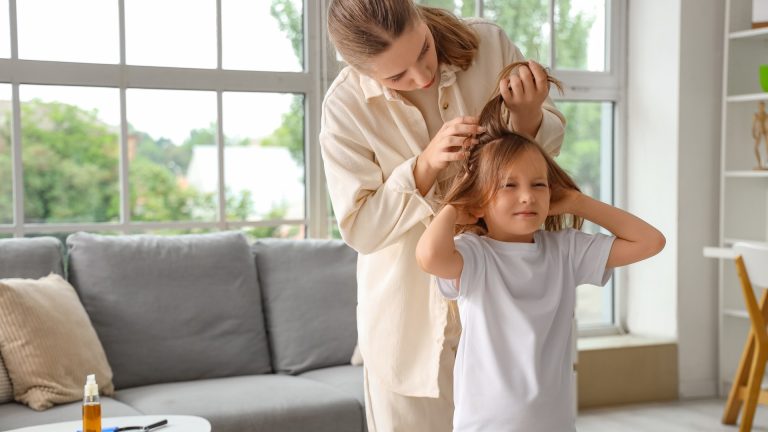

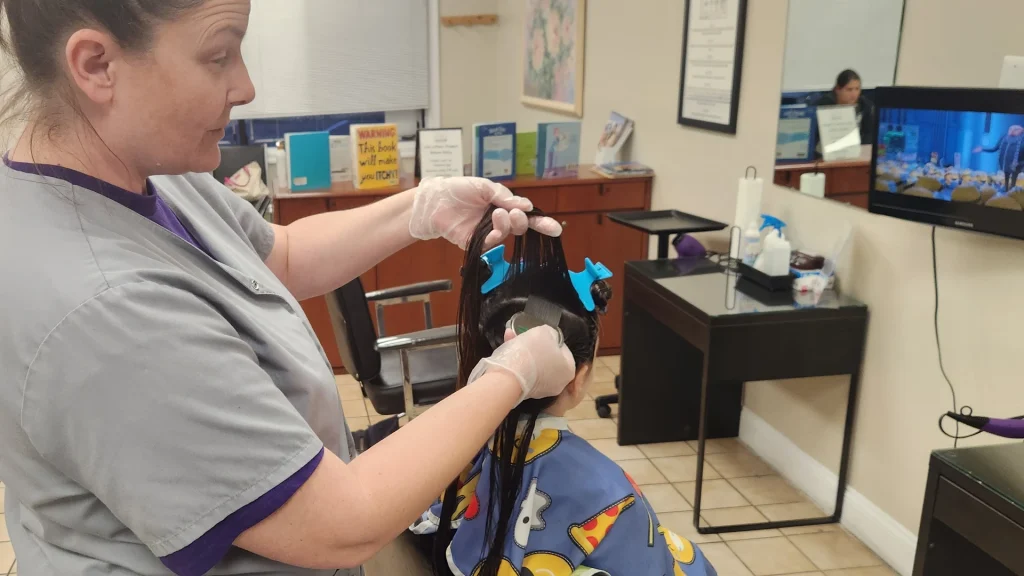
Check your child’s head by seating them in a brightly lit room, parting the hair, and combing wet hair in small sections with a fine-tooth louse or nit comb, wiping the comb on a wet paper towel after every pass. One finding settles the question: a live, crawling louse or nymph on the scalp or hair. Start at the hairline at the back of the neck and behind the ears, then work across the whole head instead of glancing at the part line.
Set Up the Check: One Comb, Good Light, Wet Hair
The whole kit is one fine-tooth comb, a bright room and wet hair. The CDC’s head lice overview says a fine-toothed louse comb may help you find lice, and the AAP’s parent guide to head lice is just as plain about the setup: seat your child in a brightly lit room and part their hair. Nothing here calls for a special product.
It helps to know how small the target is. An adult louse runs about 2 to 3 mm long, roughly the size of a sesame seed, and the AAP says live lice are hard to find because they avoid light and move quickly.
Two practical notes. A nit comb sold for lice is the standard tool, and the CDC says flea combs made for cats and dogs are also effective, so a pet comb in the drawer is not a silly idea. And if the check turns into a treatment the same evening, remember that the CDC says not to use a conditioner, or a combination shampoo and conditioner, before lice medicine.
Comb in Small Sections, Starting at the Back of the Neck
Start where lice are easiest to find. The AAP says that is the hairline at the back of the neck or behind the ears, and the CDC says you will often see nits on hair behind the ears and near the back of the neck. The AAP adds that most of the itching happens in those same two places.
The AAP describes the comb-out in four steps:
- Wet your child’s hair.
- Use a fine-tooth comb, a louse or nit comb, and comb through the hair in small sections.
- After each comb-through, wipe the comb on a wet paper towel, then examine the scalp, the comb and the paper towel carefully.
- Repeat until you have combed through all of your child’s hair.
Two details decide whether a pass was worth making. Part the hair all the way down to the scalp in very small sections, and study the scalp itself as well as the comb, because lice attach their eggs to hair close to the scalp. The CDC says lice live mostly on the head, but also on the eyebrows and eyelashes.
One honest caveat from the AAP: the comb-out can help you check for nits and head lice, but it usually does not work on its own to get rid of them. Combing is how you find an infestation and how you keep checking afterward, not the treatment.
Live Louse, Old Nit or Dandruff: What Your Finding Means
A live crawling louse or nymph is the finding that settles it. The CDC calls finding one on the scalp or hair the best way to diagnose a head lice infestation, and MedlinePlus says a diagnosis usually comes from seeing a louse or nit. A nit on its own needs a second look, and what matters is its distance from the scalp.
The CDC puts that boundary at 1/4 inch. Nits attached firmly within 1/4 inch of the base of the hair shaft are the ones that count; nits farther out are almost always hatched or dead. The AAP draws the same line in millimeters, at 4 to 6 mm from the scalp.
| What you found | What it looks like | What the CDC and AAP say |
|---|---|---|
| A crawling adult louse | About 2 to 3 mm, the size of a sesame seed | The best way to diagnose an active infestation |
| A nit within 1/4 inch of the scalp | Oval, 0.8 mm long, usually yellow to white, firmly attached | A nit that may still be viable; nits hatch in about 6 to 9 days |
| Nits only, all farther out than 1/4 inch | Empty shells left on the hair shaft after hatching | Probably an old infestation that does not need treatment |
| A speck that slides on the hair | Dandruff, dirt particles or hair spray droplets | Not lice; nits do not slide |
The pinch test sorts out everything else. Nits are held to the hair by a sticky substance that keeps them firmly in place, so they stay put when you slide your fingers down the strand, while dandruff, dirt and hair spray droplets are not attached. The CDC is blunt about how easy this call is to get wrong: misdiagnosis of head lice infestation is common. For a longer side by side, read our post on lice or dandruff on your child’s scalp.
Checking a Child Who Has Not Started Itching
Check anyway, because the itch runs late. The CDC says it may take four to six weeks for itching to appear the first time a person has head lice, and the AAP explains the lag: that is how long it can take for the scalp to become sensitive to lice saliva. The CDC also says people with head lice may have no symptoms at all, particularly with a first infestation or a light one.
The quieter signs are worth knowing. The CDC lists a tickling feeling or a sensation of something moving in the hair, irritability and sleeplessness, and sores on the head caused by scratching, which can sometimes become infected with bacteria normally found on the skin. MedlinePlus adds that head lice are most active in the dark. If scratching has already broken the skin, our post on whether lice bites cause sores covers what that looks like.
The arithmetic argues against waiting. The AAP’s reason for regular checks is that they spot head lice before the lice have time to multiply, and a female keeps adding eggs: about six a day by the CDC’s count, up to 10 a day by the AAP’s. Slumber parties, camp, sports activities and the playground are all on the CDC’s list of settings where children should avoid head-to-head contact, so those nights are sensible ones to comb.
What to Do the Day You Find a Live Louse
Check every head in the house that day. The CDC’s treatment guidance says to treat everyone infested, and anyone they share a bed with, at the same time, and it lists reinfestation after successful treatment among the reasons a treatment fails. That is the whole argument for why the whole family needs a head check rather than one child.
Treat only what you have actually found. The CDC says to treat head lice when there is an active infestation and to use the medicine as directed on the box or label. The AAP says lice medicine should be used only when it is certain that a child has living head lice, and to check with your child’s doctor before starting any of it. The CDC adds that a healthcare provider should be consulted before treating young children, and the AAP says medicine should be applied by an adult.
Skip the drastic measures. The CDC says there is no scientific evidence that suffocating head lice with mayonnaise, olive oil, margarine, butter or similar substances works, and the AAP says no studies prove home remedies such as petroleum jelly and essential oils work either. The AAP also warns never to use gasoline or kerosene or medicines made for animals, and never to put a plastic bag on a child’s head. The CDC says not to use fumigant sprays or fogs, which can be toxic if inhaled or absorbed through the skin. Our post on natural lice treatment works through the remedies families ask about.
The housework is shorter than you would guess. Machine wash and dry the clothing, towels and bed linens used in the two days before treatment, using hot water at 130 degrees Fahrenheit and high heat drying, and seal what you cannot wash in a plastic bag for two weeks. The AAP says you do not need to throw those items away. Soak combs and brushes in hot water of at least 130 degrees Fahrenheit for 5 to 10 minutes. Then keep checking: the CDC says to remove nits and lice every 2 to 3 days for the next 2 to 3 weeks.
Frequently Asked Questions
Can you see head lice with the naked eye?
Yes, though the CDC says a magnifying lens may help you find crawling lice or nits, and MedlinePlus suggests you may need both a lens and a fine-toothed comb. An adult louse is small and it moves. Overhead light and slow, small sections do more for your odds than leaning in closer.
Do I have to wet my child’s hair to check?
Yes, the method the AAP lays out starts with wet hair, so that is the version worth copying. What matters more is the mechanics: a fine-tooth comb drawn through small sections, then wiped and examined after every pass. A dry glance at the part line is not a check; it is a hope.
Can a clean head still have lice?
Yes. MedlinePlus says personal hygiene and cleanliness have nothing to do with getting head lice, and the CDC says getting head lice is not related to the cleanliness of you or your environment. The AAP is just as direct: lice attach to the hair of anyone’s head, and it does not matter whether the hair is clean or dirty.
Who else in the house should be checked?
Everyone who lives there, plus anyone your child has been head to head with. The AAP says all household members and close contacts should be checked, and treated if necessary. Adults are included: the main way lice spread is close, prolonged head-to-head contact, and MedlinePlus notes that young children often have head-to-head contact while playing together.
What if I cannot tell what I am looking at?
Ask for a second opinion before you treat. The CDC’s advice is plain: if you are not sure whether a person has head lice, see your healthcare provider. The drugs used on lice are insecticides, and the CDC says they can be dangerous if misused or overused, so a maybe is not a reason to use one.
How Lice Lifters of Ocean County Can Help
If you have combed every section and still cannot say what is stuck to that hair, bring it to us. At Lice Lifters of Ocean County we check the whole family, because the home is one of the places head-to-head contact keeps happening. When a check turns up an active infestation, our treatment is non-toxic and done in one visit, and we hold same-day appointments for the evenings when a comb-out goes sideways before dinner. Our 30 Day Guarantee applies when the whole family is checked. You can read what the professional lice treatment involves before you decide, or book a head check and let someone else do the combing.