

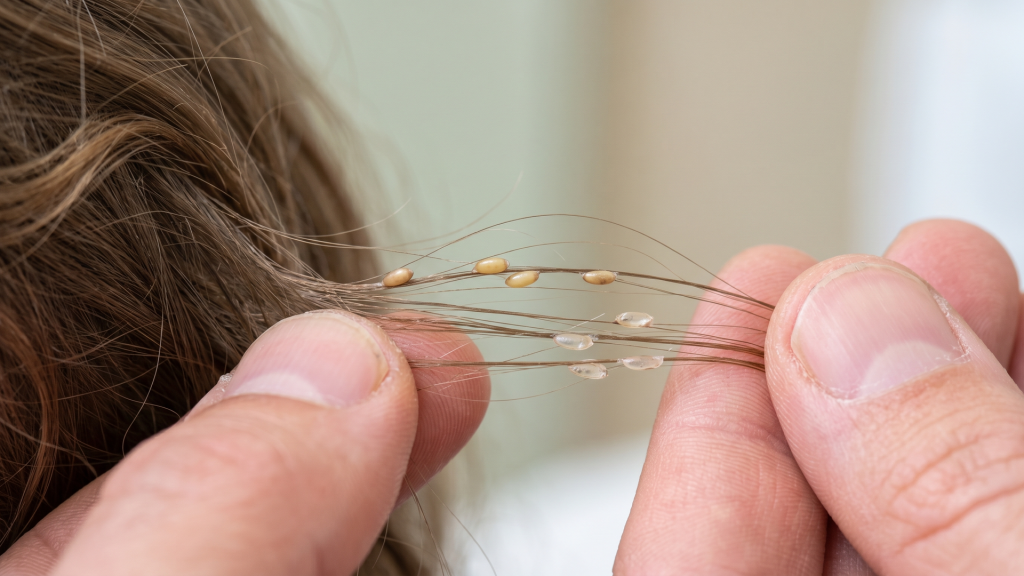
Color alone cannot tell you whether a lice egg is dead or alive. Three things help: where the nit sits on the hair, whether it is firmly attached, and what it looks like under a magnifying lens. The CDC’s head lice page says nits attached more than one-quarter inch from the base of the hair shaft are almost always hatched or dead. And it is a live, crawling louse, not a speck, that changes what you do next.
This article covers the three checks that narrow it down, the color questions parents search one by one, how far out is too far, what the sources do and do not say about popped or flat eggs, and what leftover nits after a treatment actually mean.
Live vs. Dead Lice Eggs: Three Checks That Count
No single clue settles this on its own. Three together will get you close at home: how firmly the nit is attached, how far it sits from the scalp, and what it looks like under magnification. Here is what each check tells you, and what it cannot.
- Attachment. Check whether the speck comes off the hair. The American Academy of Pediatrics says nits are firmly attached to hair while dandruff, dirt or other particles are not, because nits attach with a sticky substance that holds them firmly in place. This check rules out look-alikes, not dead eggs, since a shell left behind after hatching stays stuck as well.
- Distance from the scalp. Measure from the base of the hair shaft. The CDC puts the boundary at one-quarter inch: past that, nits are almost always hatched or dead. The American Academy of Pediatrics says eggs are usually found within 4 to 6 mm of the scalp and do not survive if they are farther away.
- A look under magnification. This is the check for telling hatched from unhatched. The CDC says a magnifying lens may help you find crawling lice or nits, which can help tell hatched and unhatched nits apart. The CDC also notes that nits are often confused with other particles found in hair, such as dandruff, hair spray droplets and dirt, so magnification does double duty.
When the checks disagree, keep looking rather than deciding from one clue. If the speck will not stay put on the hair at all, the question may not be lice: here is how a lice egg, a hair cast and a dandruff flake differ on your finger.
Lice Egg Colors, Question by Question
Color is an easy clue to reach for and a poor one to decide on. The sources overlap in a way that matters: white appears in descriptions of live eggs and in descriptions of hatched ones. Read color alongside position and attachment, never on its own.
Are white lice eggs dead?
Not necessarily, and this is the one thing worth knowing about color. The American Academy of Pediatrics describes lice eggs as usually yellow to white, and says nits can look like small white or yellow-brown specks that cling to the hair near the scalp. White turns up on both lists, so a white speck tells you to check its position and attachment, not to relax.
What color is a live lice egg?
The sources give ranges, not a rule. The American Academy of Pediatrics describes lice eggs as oval, 0.8 mm long and 0.3 mm wide, and usually yellow to white. Live eggs are described as pale in some sources and dark in another, which is exactly why color is not a verdict.
What does an empty or hatched egg look like?
A shell with nothing in it, still attached to the hair. The American Academy of Pediatrics says that after the eggs hatch, the empty nits stay on the hair shaft. None of these pages describes a shrunken or collapsed shell.
Can light hair hide a nit?
Yes. The American Academy of Pediatrics notes that some nits blend in with a person’s hair color and become hard to see. That cuts both ways on blonde or light hair: a live egg can vanish against the strand, and the pale speck you finally notice may be the one that already hatched. More on that pattern here: on blonde hair, the nit you see is already empty.
The One-Quarter-Inch Zone: How Far Out Is Too Far?
One-quarter inch is the number nearly every source lands near, though they word the boundary differently. Here is each one, in its own terms:
- CDC: nits attached more than one-quarter inch from the base of the hair shaft are almost always hatched or dead, and if the only nits found are more than one-quarter inch from the scalp, the infestation is probably old and does not need treatment.
- American Academy of Pediatrics: eggs are usually found within 4 to 6 mm of the scalp and do not survive if they are farther away.
The wording varies because the measurements do: some count from the base of the hair shaft, some from the scalp, some in inches and some in millimeters. The CDC notes that nits kept away from the temperature found close to the scalp cannot hatch and usually die within a week.
The zone works in one direction only. Far out points to a nit that has hatched or died. Close in does not mean alive, because a nit inside the zone can be dead, already hatched, or still developing, and attachment and magnification narrow that further.
Popped, Flat or Empty? What the Sources Do and Don’t Say
Parents search for this: if lice eggs pop are they alive, are lice eggs flat, what does a squashed nit mean. It is worth being straight with you about the answer. None of the six public health pages behind this article describes popping, crushing or flatness as a way to tell a live egg from a dead one, and none describes a sound or a feel as a test either. There is no published reading to apply to the result, so a popped speck leaves you exactly where you started.
What those pages do describe is narrow and repeatable: whether the speck is firmly attached to a single hair, how far it sits from the scalp, and what it looks like through a magnifying lens. Those three are the checks that carry evidence behind them. If a speck has already come off on your fingers, the useful next step is not to interpret it but to go back to the head and look at what is still attached close to the scalp.
Dead Eggs Left After Treatment: Normal, or a Reason to Act?
Finding nits after a treatment is not, on its own, a sign that it failed. The CDC says nits may stay in hair after treatment, but successful treatment will kill crawling lice.
Whether a second round is needed depends on the lice medicine and on what is moving. The CDC’s treatment guidance says some medicines kill both lice and eggs and usually need no second round, while others kill lice but not eggs, so a second round is recommended for them. Its decision rule is narrow: you should treat again only if there are live, crawling lice several days after treatment, and you should talk to your healthcare provider before re-treating. Keep checking the hair for nits and lice every 2 to 3 days for the next 2 to 3 weeks after each treatment.
If specks keep turning up and you are weighing another round, read deciding whether to retreat when nits keep showing up first, and what dead lice look like after treatment if the thing you found is a body rather than an egg.
Checking One Speck at Home
Work from the sources and keep it to five steps.
- Part the hair and work a section at a time, as the American Academy of Pediatrics describes, so you are looking at strands rather than a whole head.
- Start behind the ears and at the back of the neck. The CDC says you will often see nits on hair behind the ears and near the back of the neck.
- Use a magnifying lens. The CDC names it, and it is what separates a hatched casing from an unhatched egg.
- Test attachment before you conclude anything. Dandruff, dirt and other particles flick or wash off, while a nit does not. If it came away easily, read why a nit on your finger is almost never live.
- Finish with a wet comb-out, wiping the comb on a wet paper towel after each comb-through, and see how to comb out lice and nits for the mechanics.
One caution on that last step: the American Academy of Pediatrics says the comb-out method usually doesn’t work on its own to get rid of head lice. If the comb keeps catching and nothing lifts, why nits are so hard to comb out explains what you are fighting.
Frequently Asked Questions About Dead and Live Lice Eggs
Can dead lice eggs still hatch?
The CDC says nits take about a week to hatch, and that nits not kept at the temperature found close to the scalp cannot hatch and usually die within a week.
If lice eggs are white, are they dead?
Not on that basis. White sits in both descriptions in the published sources: eggs that can still hatch are described as usually yellow to white, and shells that have already hatched are described as white too. A white speck is a reason to check how firmly it is attached and how close to the scalp it sits.
Do empty lice eggs mean I need to treat again?
Not by themselves. The trigger the CDC names for a second round is live, crawling lice several days after treatment.
How long do dead nits stay in the hair?
The CDC says that if the only nits found are more than one-quarter inch from the scalp, the infestation is probably old and does not need treatment.
If a lice egg pops, is it alive?
The sources do not answer that question, because none of them treats popping or squeezing as a test for viability. There is no published meaning to attach to what happens. Put the speck aside and go back to the three things that are documented: attachment to a single hair, distance from the scalp, and a look under a magnifying lens.
How often should I keep checking after treatment?
The CDC gives a schedule: after each treatment, check the hair and remove nits and lice every 2 to 3 days for the next 2 to 3 weeks. The CDC adds that you should treat again only if there are live, crawling lice several days after treatment, and to talk to your healthcare provider before re-treating.
Not Sure What You’re Seeing? Our Toms River Clinic Can Look
If you have studied the same speck three times and still cannot call it, a head check can help. There is no judgment in asking someone else to look. Reliable options are professional Lice Lifters treatment and Lice Lifters products. We offer professional lice screening and treatment at our Toms River clinic, and families across Ocean County can book a head check or treatment appointment on our appointments page.